Categories
Archives by date
| S | M | T | W | T | F | S |
|---|---|---|---|---|---|---|
| 1 | 2 | 3 | 4 | 5 | 6 | 7 |
| 8 | 9 | 10 | 11 | 12 | 13 | 14 |
| 15 | 16 | 17 | 18 | 19 | 20 | 21 |
| 22 | 23 | 24 | 25 | 26 | 27 | 28 |
| 29 | 30 | |||||
In February, the American Historical Association announced its discipline-wide “Tuning” project with a grant from the Lumina Foundation. Based on previous work in the European Balogna process and a U.S. pilot project in history in Utah, the AHA will be formulating a generic list of what students leaving various history programs should know and be […]
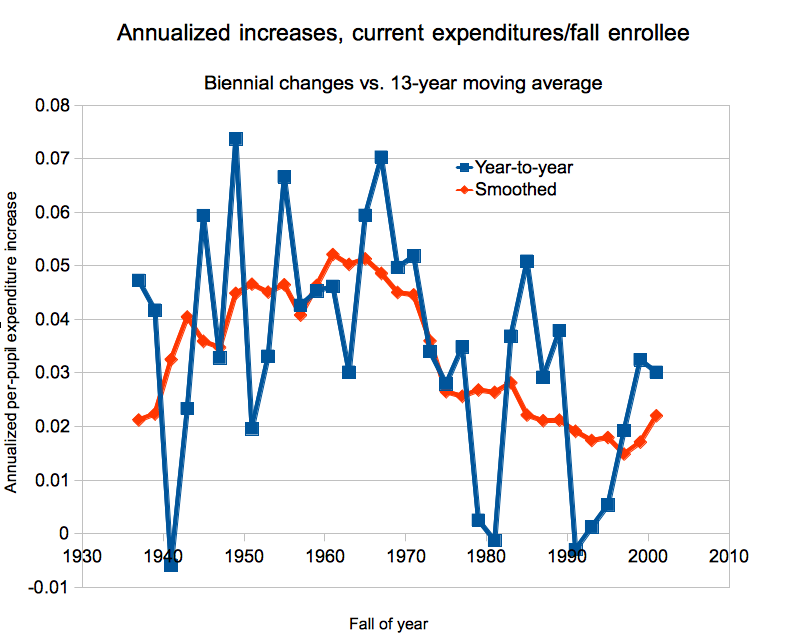
As I wrote in the entry from March 10 on manipulated charts, ((Yes, there’s a new addition there in response to Andrew Coulson.)) there’s a legitimate discussion to be had about investments in education, returns on investment, and so forth, but not if we start with manipulated presentations. What sorts of questions are relevant? I’m […]
Tyler Cowen’s discussion of higher education value is one plausible way to answer the question, What is the benefit of higher education? It’s now common that a fire chief has to have a master’s degree. That may sound silly and it would be easy to think that a master’s degree has not very much to do […]
“The time has come,” the Walrus said, “To talk of many things: Of shoes–and ships–and sealing-wax– Of cabbages–and kings– And why the sea is boiling hot– And whether pigs have wings. ((Lewis Carroll, The Walrus and the Carpenter, in Through the Looking Glass and What Alice Found There, 1872)) “… And homo economicus, and sanctions that […]
Welcome to my world, ed policy folks: small impacts can be very meaningful, but primarily in the long term. One of the sadder bits of the post-Lowrey story Chetty, Friedman, and Rockoff (s)extrapolation is the attempt to magnify the scale of outcomes beyond what the research shows. The economists concluded that the impact of shifting a […]