Rick Scott’s budget released in Eustis, belongs in Fantasyland

The summary of Rick Scott's proposed biennial budget for the state of Florida is bleak: tremendous spending cuts and attacks on public employees to pay for tax cuts concentrated for those who can afford to pay taxes. The St. Pete Times/Miami Herald state political bureau reporters are not impressed, calling today a four flip-flop day. 

I disagree with the reporters. I am mightily impressed: I didn't think Charlie Crist's fantasy budget proposals would be eclipsed nearly so quickly. I stand humbled and corrected. A tip of the hat to Governor Scott (R-Medicare Fraud): Sir, you have out-rose-colored-glassed both Charlie Crist and Johnnie Byrd. 
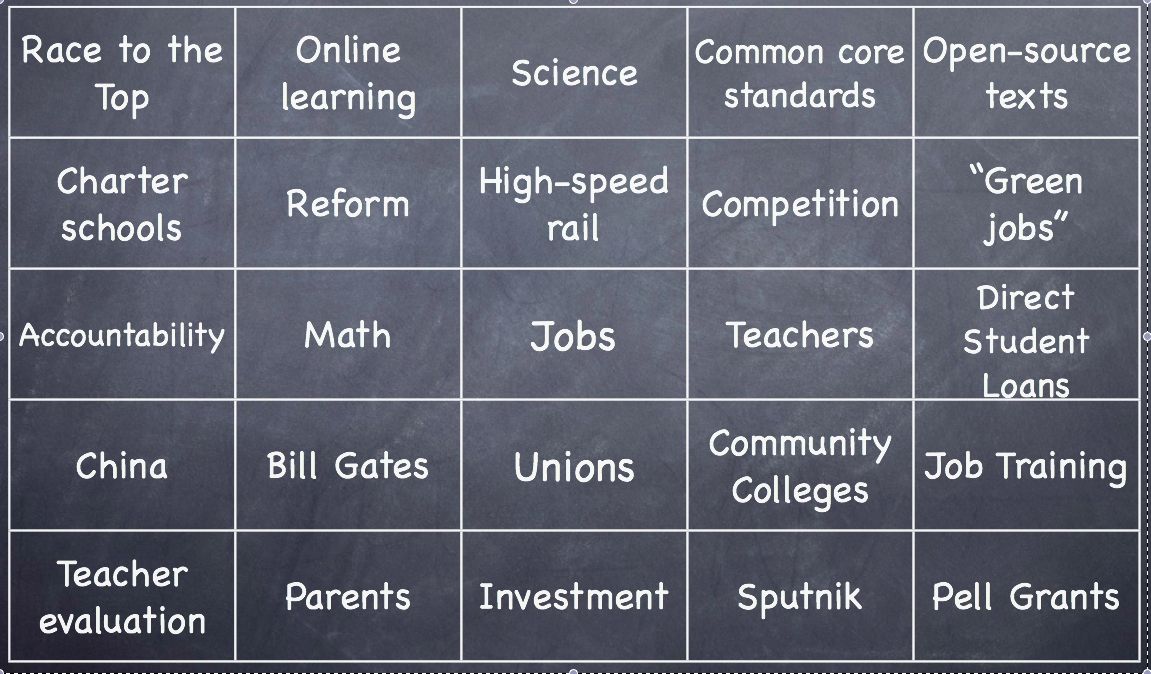
SOTUB: State of the Union Bingo

Sherman Dorn's State of the Union Bingo card, 2011

In part to make a point for (and get a minor laugh out of) my class this morning while introducing a presentation on how schools acquired the job of acquiring jobs, I put together a Bingo card for tonight's State of the Union address, using a list of words I created independently but that will look remarkably similar to the Alliance for Excellent Education bingo cards. For those interested in stuff outside education, try the Center for Global Development's bingo cards. 

Short news items

It's the start of the semester, I've acquired a few added responsibilities, and so this entry will be a combination of a few items.

  1. Planning for disaster–please turn on head. Bruce Baker and Mike Petrilli have been battling back and forth over the best ways to cut school budgets, or rather the least worst way. Petrilli has been on the colonic-theory-of-reform kick for more than a year, and his last entry looks a bit as if it's a setup for nonresponsiveness (with the implicit threat that "if the unions won't suggest cuts and only suggest tax increases, then they're to blame for what follows" with Bruce and other ed finance faculty thrown in for good measure). I think Petrilli is better than that, so let's talk instead about the best argument for looking for cuts: if you're going to make the argument for tax increases, you really want to make it from the standpoint of schools' being a worthwhile way to spend money. Denver has the ProComp performance-pay system because it was a (fairly obvious) quid pro quo for a tax referendum. Or even holding education relatively harmless compared to cuts to non-mandatory health coverage, community mental-health services, nonviolent-offender diversion/treatment programs, domestic-violence task forces, and all the other things that people desperately need. I've been ducking the poorly-aimed vitriol while reading the entries, and my instinct is that most of Baker's criticisms are well-taken in terms of suggestions not being practical. So, take a step back, assume that being willing to compromise is worth a few billion dollars, and ask: what would be the best deal? 
  2. Did anyone else notice that Michelle Rhee and Arne Duncan both visited Miami in early January? No, I'm not making any claims here other than that we live in a generally-non-freezing state in winter. Sorry: For you it may be winter. For us, it's the dry season. What?? You think that they just happened to want to highlight reform in Florida? When honchos visit us in early August, then I'll be convinced it's not the weather.
  3. Aftermath of the Tucson shooting: is it my imagination, or is it written somewhere in a TV news producer's contract that if there's a shooting that kills more than one person, you have to send a camera crew out to find at least one person who was acquainted with the murderer to explain why the murderer was obviously seen as a creep for years and years? I think all of us could be labeled as creepy in some way by someone who knows us or knew us or had a vague and faulty memory of knowing us as creepy. But there are roughly 5 murders in the U.S. for every 100,000 person-years lived, and our life expectancy right now is a little under 80 years. Being perceived as creepy is not a very good predictor of murder, though you can generally extrapolate from the murder to the post-hoc claim of accurate anticipatory judgment. Let me get in on the game: you're going to die. So am I. There, two 100% correct predictions. 
  4. Black swans for education in 2011? We already have it, called the economy and the condition of state budgets. 
  5. Gotham Schools has the best take thus far on the pending Jeanne Allen rate-the-reporters project. When this appeared last week I emailed the Gates Foundation media-relations folks to ask for an explanation of why Gates was a funder, and I have heard nothing. At first glance, this appears to be a foolish investment that is going to make the Gates Foundation look self-serving: at some point, the project is going to rate coverage of Gates work, making it appear as if Gates is trying to put pressure on reporters to shape the way Gates is being reported. I thought the Ed in '08 disaster would have chastened program officers a bit more before another misadventure (or more likely another fizzle) in media relations…
  6. A small rural newspaper in Central Florida has a solid piece by Merissa Green on tensions between local charter schools and Polk County school district officials over the administrative overhead charges for the district's supervision of charter schools. Hat tip to the St. Pete Times blog. 
  7. The iPad has passed my Ultimate Work Test: 86 job applicants for a faculty position, all submitted electronically. I didn't have access to the materials until 8 days ago. Over the weekend, I scooped the PDFs, sent them to the iPad, settled them into a folder in GoodReader, and went off to various places with caffeine with just an iPad and a sheaf of review-comment pages. First round of reading, DONE. Hours spent? Probably 15. Hours I would have spent if I had not had PDFs or the iPad? At least 10 more, and they would have been worked around lots of other things, especially if I would have needed to go to an office to see physical applications. 

Cillizza channels Vizzini

Sometimes you gotta laugh to avoid crying at the ignorance of the punditocracy. In the 1990s, mostly-GOP consultant Dick Morris advised President Clinton to triangulate, which we learned meant moving to the center and thereby hoping to steal your opponents' rhetorical thunder. Here comes Chris Cillizza, either redefining or misunderstanding the term: 

Former Massachusetts Gov. Mitt Romney, the de facto frontrunner in the 2012 field, drew national headlines when he came out against the tax cut compromise in a USA Today op-ed…. Romney wasn't done triangulating during the lame duck. He also opposed the new START treaty that the Senate approved in the waning days of 2010. [emphasis added]

Cillizza, Triangulation, Republican-style.

So when Democrats triangulate, they move to the right, and when Republicans triangulate, they move to the right, too? In the words of Inigo Montoya, Mr. Cillizza, you keep using that word. I do not think it means what you think it means.