Non-profit as trade association? (Bush foundation allegations)

If anybody had time yesterday to browse the In the Public Interest collection of emails from the Foundation for Excellence in Education, it wasn’t me. I’ve read a few accounts, such as the one on Valerie Strauss’s blog, so the following is a short, initial impression based on someone else’s summary of a few items from the collection.

  • I separate the allegations that the foundation is serving essentially as a trade association from the allegations of personal conflicts of interest. They are two very different issues, though they are being treated as identical. One is a question of organizational role and transparency: Foundation for Excellence in Education looks very different from the Foundation to Advance the Testing and Online Huckster Industries. The other is a question about whether a non-profit is being used to serve the financial interest of a key person (Jeb Bush).
  • The question of foundation-as-trade-association is one I am not competent to judge. If the charter for the foundation is consistent with indirectly advancing the interests of one or more industries, and none of the specific activities violate federal law involving non-profits, then the worst one can say is that the foundation is operating on the marginal side of ethics (and possibly not that, depending on the range of non-profit activities). Journalists can do some good work here by consulting with tax attorneys with expertise in non-profits. But we need a little homework on the legal front before condemning FEE. 
  • The question of a personal conflict of interest is both more serious and simpler to resolve. In the Public Interest is strongly suggesting that Jeb Bush personally benefitted by FEE’s pushing the use of SendHub, a tech firm in which Bush became a visible investor in late 2012. One of SendHub’s founders is a former Bush aide, but note that “late 2012” date (October, I think)? At least one of the emails from Patricia Levesque mentioning SendHub is from February 2012. I could not find the other emails mentioning SendHub on the website with the documents, but if the pushing of SendHub is from the first half of 2012 or earlier, it looks like casual back-scratching of people in the same circle. The only catch: Garrett Johnson (from SendHub) sits on the board of the Foundation for Florida’s Future, which also employes Levesque. That relationship could present a conflict of interest, depending on when Johnson began on the board (again, journalists need to talk with an expert in non-profit management). But unless there is an email pushing SendHub after Bush became an investor, it’s not an obvious conflict of interest for Bush personally.

I think most readers of this blog would correctly infer that I strongly disagree on a broad range of education policy with Governor Bush, Patricia Levesque, and other staff of both FEE and the Foundation for Florida’s Future. It is very tempting to go after your policy opponents if something appears to present shady dealings that could be a political trump card. I don’t see that here. Right now, all we have are records of some transactions and communications. Depending on non-profit law and FEE’s charter, that could mean something illegal or squat. But no one has yet done the homework to justify the allegation of an improper conflict of interest. At most, all anyone has demonstrated is that Patricia Levesque is an effective trade association representative, no matter who’s employing her.
Five oft-overlooked facts about Barack Obama and education

Technically, President Obama’s second term starts tomorrow at noon EST. Chief Justice John Roberts will swear in the president privately at the White House, perhaps as an extra rehearsal to make sure the public “swearing-in” on Monday goes off without a hitch. Below are five overlooked facts about Barack Obama and education:

  • Barack Obama was a college “swirler,” or someone who attended multiple colleges. Unlike most adults who swirl among multiple colleges and universities, Obama attended two elite private institutions, Occidental College in California and Columbia University in New York. But like millions of other Americans, the president transferred between institutions.
  • Neither Barack Obama nor his children have ever attended public schools in the United States. Obama attended several schools in Indonesia, then a private school in Hawaii, and two private undergraduate institutions before Harvard Law School. His children attended the University of Chicago Lab School and now attend Sidwell Friends School.
  • The White House website does not have a single speech where President Obama discusses desegregation in schools since 1960. If you search the White House site for the word “desegregation,” you can find about two dozen entries, but none is a speech where the president discusses segregation in today’s schools, or schools any time in the past half-century.
  • Arne Duncan is the fourth consecutive Education Secretary with previous political connections to his or her appointing president, a streak now stretching over 20 years. Duncan and Obama are close from Obama’s Chicago years. Clinton’s education secretary was Richard Riley (1993-2001), who was governor in South Carolina while Clinton was governor in Arkansas. Rod Paige (2001-2005) was superintendent in Houston for George W. Bush’s entire time as governor in Texas, and Margaret Spellings (2005-2009) was a member of Bush’s inner circle in both Texas and Washington.
  • Barack Obama is the third consecutive president to have pre-presidential experience with modern education reform. In Chicago, Obama was the founding board chair of the Chicago Annenberg Challenge. Before him, George W. Bush and Bill Clinton were both governors claiming a track record in education reform policy.

Overdone test preparation threatens the civil rights of students

Today is the 84th birthday of the Rev. Martin Luther King, Jr. When he and other civil-rights leaders fought for equal schooling in the decades after World War 2, they never would have imagined the level of test preparation we see today, test preparation falsely justified in the name of civil rights. In the name of equal educational opportunity, Congress and former President George W. Bush created the No Child Left Behind Act of 2001, and in the past decade and more, school districts across the country have purchased test-prep booklets, mandated that teachers spend hours on narrowly-focused test preparation, and restricted access to the broader curriculum. Instead of supplementing the school day, test preparation has supplanted the general curriculum.

It is time we recognize that both the concrete resources and the time devoted to test preparation threaten the civil rights of students. When schools with low academic achievement receive test-prep booklets, the cost of those purchases is stolen from instructional materials for the general curriculum. When children with low academic performance find their classroom time occupied by activities that mirror multiple-choice test formats, that is a denial of access to a broad curriculum. When teachers, aides, school counselors, and others spend hours in early spring drilling students on test-taking techniques, that is time that children are not reading, are not learning about math and science and history, and are not experiencing or creating art or music.

Unfortunately, the Obama Administration has done nothing to stop the annual spring flood of test preparation. Repeatedly, President Obama and Secretary Duncan have given lip service to the dangers of “teaching to the test,” but I have seen the Administration take no specific steps to stop test prep where it endangers the education of the students most vulnerable to its effects. In this week, leading up to President Obama’s second inauguration, it is time for the Administration to step beyond uttering parent-pleasing phrases.

Today I have created a petition on the White House website, which by current Administration statements will draw an official response if it receives 25,000 signatures in the next 30 days. If you agree with me that anything more than minimal test preparation is a risky practice for young children, please read and sign the petition:

We petition the Obama Administration to recognize that test preparation can violate the civil rights of students.

President Obama has said he opposes teaching to the test. Test preparation interrupting the curriculum has no value beyond the test. Disadvantaged children are especially vulnerable to such test prep; these children are disproportionately affected by teaching to the test. The President should affirm the following:

1) Diversion of resources for short-term test score increases can materially violate students’ civil rights.

2) Student and personnel assignments for short-term score increases can violate students’ civil rights.

3) School employees are protected from retaliation when they complain about test prep’s disproportionate impact on students.

4) The Office of Civil Rights has the President’s support to address complaints of disproportionate test prep as civil rights violations.

To sign the petition (and to draft your own petition), you need to register first at https://petitions.whitehouse.gov/register and then you can sign the January 15 petition on the threat that test preparation poses to the civil rights of students at https://petitions.whitehouse.gov/petition/recognize-test-preparation-can-violate-civil-rights-students/WrVrkGl9.

I have drafted this petition because I have waited four years for the Obama Administration to act, and I am tired of waiting. In Florida and across the country, there are hundreds of thousands of children enrolled in districts that confuse test preparation with good instruction. The children who most need better instruction are instead the targets of more test preparation or a haphazard mix of some good instruction and far too much test prep. Teachers and principals feel pressured to purchase and use test-prep materials, and advocates of high-stakes testing have been largely deaf to our concerns as parents.

If you are a parent, how can you tell that your child is being subject to inappropriate test preparation?

  • If your child is required to attend intensive test-preparation as part of the school day, as opposed to offering preparation after the end of the day or during weekends, you should be worried about what your child is missing.
  • If something that looks like test prep is happening in the six weeks before testing, and then those activities disappear after the tests, it is narrow test-prep.
  • If booklets come home as “homework” where all the activities mirror the test formats in your state, it is narrow test-prep.
  • If your child asks why art and music and history and science have disappeared in the last few weeks, your child’s education is being affected by narrow test-prep.
  • If your child is subject to extensive test preparation in a grade where there are no or low stakes for students (i.e., tests are not used as a promotion gateway or a graduation requirement), it is test-prep in the school district’s interest, not your child’s.
  • If your child complains about test preparation, your child is probably right.

Who is at fault? I blame both policymakers and school boards for this situation. I blame policymakers for not owning the problem of test preparation, and I blame school boards for caving in to high-stakes pressure with short-term, tactical moves that improve test scores but interrupt students’ access to the curriculum. School boards should resist these pressures, confident that good instruction is the most ethical response to accountability. State legislators need to own test prep as a problem, or they deserve blame. And President Obama and Secretary Duncan should be leading the charge against test preparation by declaring it a potential threat to civil rights rather than paying only lip service to parents’ and educators’ concerns.

Gun debates need a harm-reduction approach

Among the various discussions about guns and schools in the past half-week, there is one concept that is missing: a harm-reduction framework. The current Supreme Court has ruled that the Second Amendment includes an individual right to own weapons, and it is unclear what sort of regulations might pass court review. The promises by legislators such as Diane Feinstein to introduce weapons bans in the next session of Congress come from a clear moralistic framework: the murders of children in Newtown, Connecticut, were abhorrent, and legislation is justified by our horror at the murders.

I think that is a mistaken approach. Not necessarily the idea of regulating weapons or ammunition designed to kill many people easily, but reasoning from a moral framework on an issue of public health. I have seen that happen all too frequently in my life, and thanks to my being an historian, for decades before then. Whether it is about sexuality, substance abuse, or access to guns, reasoning about public policy too often bases public policy on simplistic assumptions about human behavior.

As a parent, I stand with the majority of my fellow parents in preferring a harm-reduction strategy on sexuality and substance abuse. I don’t think it’s healthy for young teenagers to engage in sex, but we need comprehensive sex education because it is more important for teenagers to avoid pregnancy and STDs than for politicians to pretend that abstinence education works. I have never smoked pot, used cocaine, heroine, or a bunch of other illegal substances, but I am all in favor of needle exchange programs because it is more important to stop the spread of HIV and hepatitis than for politicians to pretend that laws prohibiting drug use eliminate all drug use.

Two of my cousins are pediatricians, and it is now standard practice for pediatricians to ask parents if they have guns in their house. Gun use is a public-health issue and should be addressed as such. That means we should design public policies around harm reduction. I am not exactly sure what that would look like, but it would be very different from what I’ve read in the past few days. If you want to moralize, go ahead. Then address in my reality the fact that thousands of teenagers walk around with guns.

“I read Nate Silver. I’m a fan of Nate Silver. State senator, you’re no Nate Silver.”

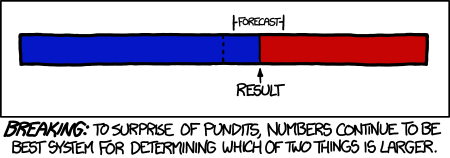
"Breaking: To surprise of pundits, numbers continue to be best system for determining which of two things is larger."

The takeaway from the Nate Silver-punditry smackdown this fall is not that any quantification and set of algorithms beat the pants off your nearest broadcast yodeler, but that quantification done well will beat the pants off your nearest broadcast yodeler, and that your nearest broadcast yodeler presents the equivalent of the Washington Generals in battles with professionally competent quantification.

Continue reading ““I read Nate Silver. I’m a fan of Nate Silver. State senator, you’re no Nate Silver.””