Like many others, I’ve been enjoying playing for at least a few minutes with the new Google Ngram viewer. So what can one see when you put in the phrases school accountability and school efficiency in the Google Ngram search box?
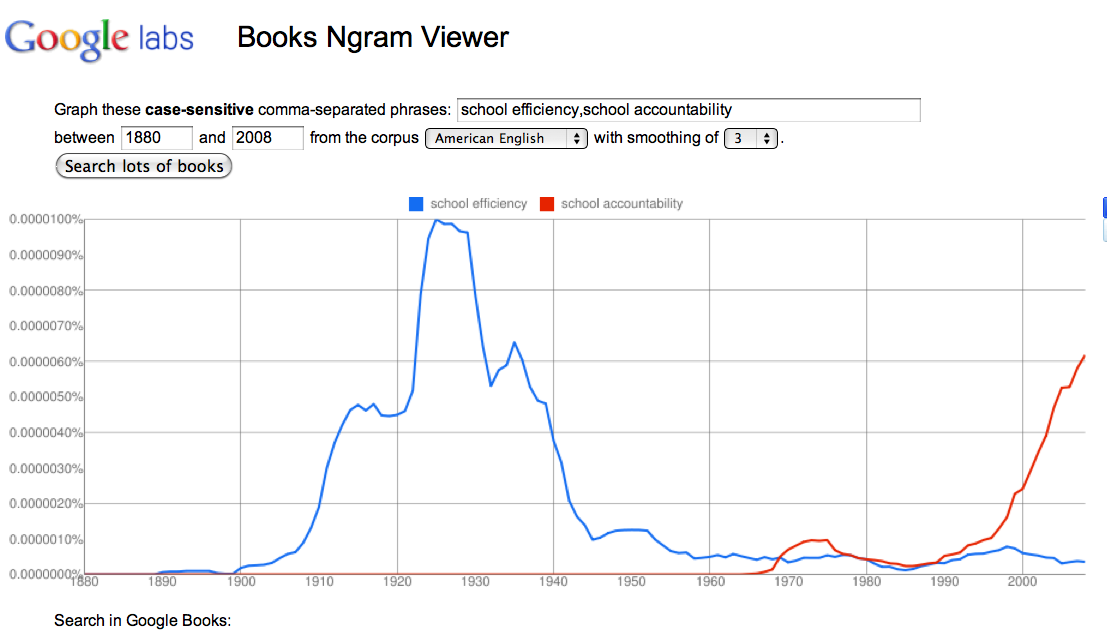
id=”attachment_2895″ align=”aligncenter” width=”300″ caption=”Efficiency and accountability terms in Google Ngram viewer (American English data)”
The blue line is the proportionate set of sources in the Google database (by year) with references to “school efficiency,” and the red line the proportionate set of sources with references to “school accountability” (each smoothed, I think an average of three years). “School efficiency” references peaks around 1925 (at one reference in every ten million sources or so); “school accountability” references begin to appear at the end of the 1960s and are still rising. Given the incomplete nature of the Google database, the relative amount of print matter over the time series (and thus the ability of a small professional literature to look much larger in the early 20th century than a similar or even larger bit of rhetoric half a century later), and all the vagaries of picking different keywords (or phrases), all I can comfortably conclude here is about timing, not dominance: that efficiency is an older term used in the “run schools as businesses” public rhetoric, and accountability is a term that has been in use only in the past 50 years and picked up steam in the 1990s. Not that this is a surprise to an historian of education…
I started with the question of whether the Ngram viewer would provide evidence of the conclusion that I had reached in my research in the 1990s, that dropout only became a prominent term in the 1960s. It does.
More on the limitations and addictive quality of the Ngram viewer over at Dan Cohen’s blog. If you’ll forgive my bastardized Latin, caveo computus.
Neat tool! The graph you pulled makes me wonder (without doing any research beforehand) whether the proliferation of the term “efficient” in state constitutional education clauses led or lagged that 1920s peak. I would guess the former, but many state constitutions were revised or completely replaced in the 20th Century.
Scott,
I’m guessing the opposite: lagged.
I’m definitely going to check that out after I finish procrastinating over these civil procedure exams.
Sherman,
Okay, my quick online research reveals that both of our guesses are right, depending on the state. Here’s the list of states with “efficient” as one of the requirements of their education articles, and my best determination of when each provision was adopted:
Arkansas 1968.
Delaware 1897.
Florida 1998.
Illinois 1870.
Kentucky 1891.
Minnesota 1974.
New Jersey 1947.
Ohio 1851.
South Dakota (unclear, either 1851, or sometime between 1930 and 2000—constitutional history is very sparse online).
Texas 1876.
West Virginia 1872.
Wyoming 1889.
–Scott