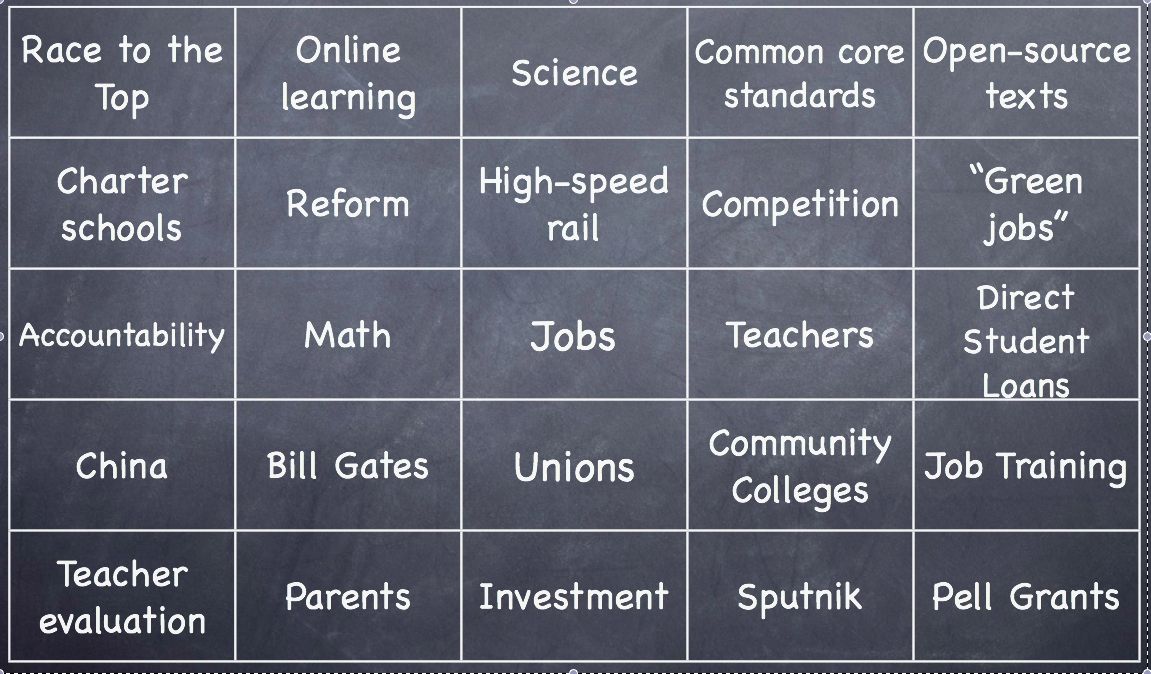
SOTUB: State of the Union Bingo

Sherman Dorn's State of the Union Bingo card, 2011

In part to make a point for (and get a minor laugh out of) my class this morning while introducing a presentation on how schools acquired the job of acquiring jobs, I put together a Bingo card for tonight's State of the Union address, using a list of words I created independently but that will look remarkably similar to the Alliance for Excellent Education bingo cards. For those interested in stuff outside education, try the Center for Global Development's bingo cards. 

Monday meetings and social debt

A few years ago, someone who was in a position to know said that the only day of the week to start a meeting with school leaders (especially superintendents) was Monday, before fires popped up that had to be put out. Some weeks I think the only day of the week to get work done sometimes is Sunday, before meetings pop up that have to be attended. Meetings today 11 am – 1 pm, 1 pm – 3 pm, 3:30 pm, and that doesn't include people catching me in the hallway. What I'd rather do:

  • Finish a grant proposal draft I owe someone
  • Finish a book chapter manuscript I owe someone else
  • Finish a recommendation letter I owe yet a third person
  • Finish reviewing a manuscript I owe a fourth person (a journal editor)
  • Finish planning tomorrow's class

So I'll work on one of those items in the next hour. 

Craftwork academe

Last semester, a doctoral student at USF asked me, what were the methods of historians? I responded by talking in general about the uses of archival materials, publications, oral histories, multimedia, statistical data, all sorts of primary sources … and realized quickly that was not what the student meant or needed. What the student was hoping for was some methodical way of working with primary sources and a sense of what historians thought was acceptable and not.

Continue reading “Craftwork academe”

NYC teacher “value added” and the veneer of factuality

Teachers College sociologist Aaron Pallas takes a New York judge to task for miscategorizing what is Fact Or Opinion in the ruling to let the internal NYC "teacher ratings" become public. (The issue is on appeal, and the judge's ruling is stayed while the appeal is pending.) Essentially, Pallas's point is that with such uncertainty about the accuracy of the value-added scores (including concerns about misattribution of students to teachers), the numbers assigned to teachers cannot be described as facts.

In an abstract and pure-research way, he is correct. But in another (very cynical) way, it is precisely the job of technocratic apparatchiks to create facts that can be used in political judgments, accuracy be damned. My colleague at USF Stephen Turner makes this point in Liberal Democracy 3.0, that one function of courts and commissions is to allow fact-finding (or the creation of social facts) to be displaced away from the political arena, so that political discourse can focus on what to do about the social facts rather than the messy thing of what is reality in the first place. I leaned heavily on Turner's argument for one chapter in Accountability Frankenstein, and the hard-edged interpretation of test scores, school "grades," and AYP designations is this creation of facts or at least the veneer of factuality. No wonder the judge bought into this framework, because that is a recognized role of juries, initial hearings, expert witness testimony, and so forth. 

So how could one burst through this veneer? I can imagine the following line of questions at hearing, at least up to a certain point:

Continue reading “NYC teacher “value added” and the veneer of factuality”

New York Times reporters and editors fail reading comprehension test

First read this headline: Test-Taking Cements Knowledge Better Than Studying, Researchers Say. And the lede: "Taking a test… helps people learn, and it works better than a number of other studying techniques."

Now read the following text:

Without the [chosen] passage in front of them, they wrote what they remembered in a free-form essay for 10 minutes. Then they reread the passage and [again wrote down what they remembered in a free-form essay].

In the study published in Science, the summarize-the-reading exercise was a better route to remembering material a few weeks later than just reading a passage, unguided "studying" of the passage repeatedly, or drawing a concept map. I'm not that surprised by the results because I have generally been unimpressed with concept maps; they usually omit verbs, which are important types of words when working with any language.* 

But suddenly, the idea of summarizing a passage in your own words, which I used to call note-taking, is now called test-taking, at least for the purposes of the headline. So when was the last time you sat down for a test and there was one prompt: "Tell me everything you remember reading for the course"? Me, neither. 

So why did Pam Belluck call it "test-taking"? I've emailed her but have not received a reply and do not expect one. 

* Highly annoyed by verbless writing. Issue. Fragments. Avoidance of intellectual commitment. Problem. Data collection. Pondering. Reporting of findings. Banality. Solutions. Resistance by entrenched interests. Snores but does not have sleep apnea. Political. Social. Economic. Boxes and lines not substitutes for verbs. PowerPoint.** 

** May your days be filled by climbing beautiful mountains and your enemies cursed by having to communicate in bullet points.