L.A. Times crash-and-burn report

Now that the L.A. Times has made its database on teachers and its VAM scores public, we can and should hold the Times accountable for whether it has responded to concerns professionally. Here is what Jason Felch, Jason Strong, and Doug Smith wrote in part to Jay Mathews in response to his concerns:

… teachers and schools will not be receiving numbered percentile rankings, which imply a level of precision that is not possible with these estimates. Rather, their relative position will be shown along a spectrum of effectiveness in a way that visually indicates the inherent imprecision of these estimates.

So far, so good at least in terms of words. What does this mean? When researchers show distributions of scores, they often show error bands to indicate "the inherent imprecision," as Felch, Strong, and Smith wrote. For example, see the following figure from a 2000 paper by Kenneth Rowe on value-added measures:
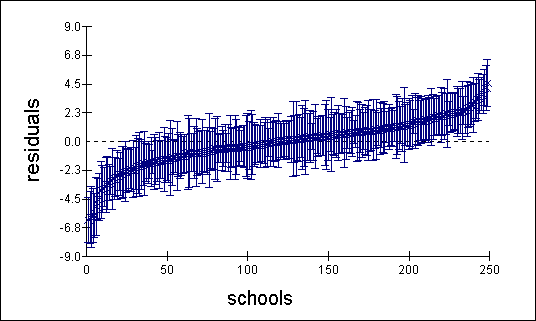
Graph of schools with value-added point estimates and 95% confidence intervals, showing significant overlap

The point here is that showing imprecision is easy to do in a way that is professionally competent.  Is that what the L.A. Times shows in its database? Here's the chart for one teacher:
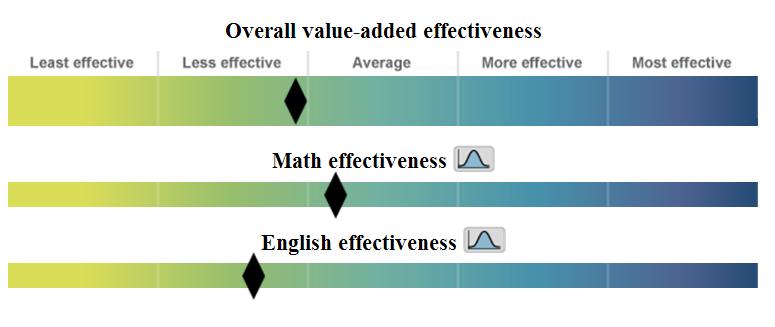
Sample chart from L.A. Times

There are two graphing sins here: dequantification and an implication that the estimate for the teacher is infinitely accurate (or at least as accurate as the center of the diamond images). I don't know what the Times editors and reporters thought they were doing by eliminating a scale, but this doesn't remove the central problem of visually implying that the estimate of effectiveness is precise. Instead, it commits the sin of dequantification. To borrow from Edward Tufte, is the L.A. Times' publication of these figures an act of reporting or finger-painting?

It also raises significant questions about the response to Jay Matthews. Was the Times deliberately trying to fudge what they were intending to do with the graphs, or are they really so incompetent an organization that they don't have people who know how to design statistical figures and also didn't check such a high-stakes display with people who do this professionally?

For those who wonder if there are written ethical guidelines for journalists, you'd want to look at the Society of Professional Journalists' Code of Ethics, specifically the section on minimizing harm, including the following:

Journalists should:

— Show compassion for those who may be affected adversely by news coverage. Use special sensitivity when dealing with children and inexperienced sources or subjects….
— Recognize that gathering and reporting information may cause harm or discomfort. Pursuit of the news is not a license for arrogance.

In the charts it published today, the Times blatantly misrepresents the accuracy of its statistical model results for people who did not choose to have their names in public. Those who read Brad DeLong's blog will recognize the style of the title. I am not nearly as dyspeptic as he is regarding newspapers, but this is sheer arrogance about the consequences of publication without regard for competent representation of information.  

Update: see Bill Boyarsky's comments from September 2 for another journalist's take.

EPI publishes white paper on value-added/growth measures and teacher evaluation

Just after midnight, the Economic Policy Institute released a relatively short white paper coauthored by ten well-known researchers, Problems with the Use of Student Test Scores To Evaluate Teachers. Key passage from the executive summary:

A review of the technical evidence leads us to conclude that, although standardized test scores of students are one piece of information for school leaders to use to make judgments about teacher effectiveness, such scores should be only a part of an overall comprehensive evaluation. Some states are now considering plans that would give as much as 50% of the weight in teacher evaluation and compensation decisions to scores on existing tests of basic skills in math and reading. Based on the evidence, we consider this unwise. (pp. 1-2)

The strongest passages of the 29-page paper contain the summaries of research on the limits of value-added or growth methods. On first reading, it's a clear explanation of the concerns many people (including I) have with a Procrustean approach to using student test scores for teacher evaluation.

Also see early responses by Maryland teacher Ken Bernstein and Atlanta Journal-Constitution reporter Maureen Downey.

Galactic threats to higher education and software development

It's the start of another school year, and evidently there was a sufficient threat to the Massachusetts Institute of Technology to bring the Doctor openly to campus. But I'm not so sure he's going to succeed, because though there are some scurrilous rumors the attached recording came from the recent Google-Verizon talks, I suspect the reality is dangerous alien opposition to open source software development and net neutrality. Are they responding to the recent Copyright Office declarations on fair use?

Colbert “University”

At the bottom of this entry is the embedded 7-minute clip from Wednesday's Stephen Colbert Report segment on college.

As usual, the Colbert Report writers neatly skewered for-profit scams, and then Colbert interviewed Andrew Hacker, one of the authors of Higher Education?. I will have more to say about Hacker and Claudia Dreifus's book next week or the week after, but the connection was both timely and a nice boost for Hacker and Dreifus.

The Colbert Report Mon – Thurs 11:30pm / 10:30c
Stephen Colbert University – Andrew Hacker
www.colbertnation.com
Colbert Report Full Episodes 2010 Election Fox News

OMG–helicopter parents!

Some observations as my daughter watched her friends head to college in the past week and then moved in herself:

  • One friend of my daughter reports that her roommate at a public university brought a flat-screen television along with a microwave and mini-fridge. At first, my daughter thought that this was stereotypical university overindulgence. No, responded the friend: it's the roommate's parents who are that indulgent.
  • When my daughter and I arrived on her campus yesterday morning, we went our separate ways for an hour: she to do all the bureaucratic stuff, me to get a bite to eat and relax on the campus cafe's patio. The student who followed her out of the parking lot towards the first station? Accompanied by two parents and two or three siblings (I forget).
  • I saw several trailer-containers with more than a few cubic feet of space, and parked in the (only) driveway in and out of one parking lot was a Ryder truck (not a trailer or a van). I can only hope that the truck had stuff for several returning students.
  • The administrator who greeted me at a morning reception seemed a bit surprised that I had dropped my daughter off with a few suitcases and odds and ends and didn't know what she was doing at the moment. Then he praised me.

Yes, my daughter's college had a reception for parents and an explicit time at which they had scheduled "parents say good-bye and go away." As a result, I think I better stop making fun of today's parent-handling routines. I'm sure that some of my classmates also had helicopter parents, but I got to my college in the evening of move-in day after traveling cross-country with a suitcase and trunk, and by the time I had dragged everything to my room, I was exhausted, and it was dark. If anyone brought a vanful, I wasn't going to know.

By the time of the afternoon hug-and-go deadline yesterday, I was on my flight back to Tampa–I teach T-Th 8 am classes this semester. I would have loved to stay in the area to visit some friends and enjoy sub-90 F. weather (oh, the cafe patio and the outside part of the reception was wonderful–temperatures in the mid-70s), but I think the only practical thing I could have done was shuttle my daughter to get (or get on her orders) odds and ends that don't make sense to pack for a plane trip. That's what care packages are for (this week's: a coffee grinder, filter, and other accoutrements).