Why shared governance is such a damned good thing… for administrators

After I stepped down 19 months ago from being the head of the faculty union at USF, I got ribbed by my successor about “turning to the dark side” with an appointment last August as a department chair. “More like the gray side,” I replied. (In my college, chairs are in the faculty union bargaining unit, so I am still a part of the bargaining unit and a member.) ((Seriously, folks, why are we using a 1977 corny-movie reference as the touchpoint about shifting role perspectives? And what did faculty talk about before 1977 when colleagues became chairs or other academic administrators?)) As I’ve been in that role for a little over a year, it has become much more evident in a personal way why shared governance is a good thing for academic administrators.

  1. You need faculty buy-in for the vast majority of academic things that happen on campus. This is the principled position (the faculty own the curriculum) and the conclusion one would draw from studying loads and loads of education reform at different levels (see “street-level bureaucrat” and “loosely-coupled system”). It is also the position that is required if you want department chairs and college deans to be sane. It doesn’t matter whether you are at a campus with tenure or not, or what proportion of courses are taught by tenure-track faculty. Unless you are at a for-profit institution with a cookie-cutter curriculum, there are only a limited number of directives you can give a colleague, and in my experience faculty have a pretty good sense of which requests are legitimate from a local perspective (obviously connected to a department’s functioning), which are passed on from above (e.g., with accounting rules, etc.), and which are a load of bull.
  2. Shared governance is a useful reality check for academic administrators. Every mistake I have seen myself make thus far as a department chair has been because of haste or inadequate consultation. ((Note: this is not the same thing as saying I always make mistakes when I act quickly.)) Ad-hoc processes are problematic, but there are often pressures to decide things RIGHT NOW in academe, when a round of talking with relevant parties can often provide critical information and alternatives.
  3. I don’t want to do this job forever, and it will probably be one of my current colleagues who will succeed me. That means it’s my obligation to share as much institutional knowledge with colleagues as I can and build a functioning department that can operate just fine without me.
  4. Good managers delegate a large number of tasks to people whose job descriptions include those tasks. Why would I not want to delegate as many weighty decisions as possible to people I like working with, who collectively have decades of education and experience, who have to live with whatever is decided, and who can take a good bit of the psychological burden of decision-making off me?
  5. Shared governance is an effective way to reduce the number of secrets that an academic unit has to keep. If you don’t want a decision to be shared, you and a very limited number of others need to keep control of the information. I don’t mind keeping confidences, but I have to do that anyway with personnel matters, with ambiguous situations that need waiting more than anything else, and with my role as the department’s complaint window. Why do I need to keep more information confidential than is absolutely necessary?

I recognize that I am very lucky as a department chair with my colleagues and with the staff we have. I know very well that if circumstances were different, I might be reluctant to trust important decisions to my colleagues. But the problem there would not be shared governance. If you think that avoiding shared decision-making will eliminate deep problems in work culture or a mismatch between the skills of a unit and what’s needed, then I have a bridge to sell you. More fundamentally, your energy is much better directed at the root of the issue than the various organizational machinations required to avoid shared governance at a public or non-profit college or university.
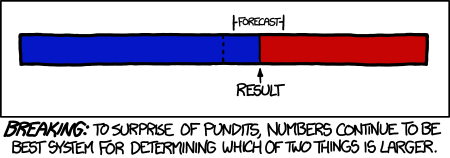
“I read Nate Silver. I’m a fan of Nate Silver. State senator, you’re no Nate Silver.”

"Breaking: To surprise of pundits, numbers continue to be best system for determining which of two things is larger."

The takeaway from the Nate Silver-punditry smackdown this fall is not that any quantification and set of algorithms beat the pants off your nearest broadcast yodeler, but that quantification done well will beat the pants off your nearest broadcast yodeler, and that your nearest broadcast yodeler presents the equivalent of the Washington Generals in battles with professionally competent quantification.

Continue reading ““I read Nate Silver. I’m a fan of Nate Silver. State senator, you’re no Nate Silver.””

BCGD: Big College Graduation Deal

A few quick comments on the new report on college graduation by Pew researchers Richard Fry and Kim Parker, which estimates 33% bachelor’s degree completion among non-institutionalized 25- through 29-year-olds (HT: NYT’s Tamar Lewin):

  • The increase in college graduation (from 28-29% before the recession to 33% now) is a noticeable boost, both for the pace of increase and also the fact that college graduation has nudged at all after more than a decade of stagnation. To paraphrase Joe Biden, this is a big deal.
  • Some of the increase may be temporary, for two reasons. Fry and Parker correctly observe that at least some of the increase is because of the Lesser Depression, as people out of work returned to school (or, as the anonymous Dean Dad put it in 2009, “it’s raining men”). Enrollment may decline as we get further from the depths of the crisis. In addition, it is possible that part of the increase may have been people shifting their college education earlier rather than an increase in the proportion with a college degree at some point in their life — some people intending to return to college at age 30 may have decided to enroll at age 27 when the economy tanked. A few years out, we can look at the 30-34 year old rates to check the second issue.
  • This increase happened in an era of huge state-level disinvestment in public higher education, where most college students attend. What was this about inefficiency and Baumol cost disease, again?
  • Wonkish caveat 1: a small number of adults in their late 20s are immigrants who moved to the U.S. after age 15 and never enrolled in high school in the U.S., and this fact may be biasing both the level of the estimate (which would be biased on the low side if you are looking at the performance of education for those who have at least some education in the U.S.) and also the trend (by the slowdown/slight reversal of immigration during the Lesser Depression).
  • Wonkish caveat 2: we do not know how much of this increase is due to the for-profit higher ed bubble. I don’t think the March Population Survey (the source of this data) asks for anything beyond attainment level for adults. You could guesstimate that via graduation counts and some assumptions about age distribution of new degrees, but that would be a separate analysis. My professional gut instinct would say that for-profit higher ed has very little impact on the general graduation rate, but my gut has no vocal cords, no degree, and no job.
  • Wonkish caveat 3: this estimate is only for “non-institutionalized” adults in their late 20s. As Becky Pettit would point out, this leaves out imprisoned adults, who have much lower educational attainment than the rest of the population. It is highly unlikely that the increase in college graduation between 2006 and today is an artifact of incarceration, but the omission of inmates from the Census Bureau samples biases the level upwards.
  • Wonkish plug: Fry and Parker downloaded the data from the Minnesota Population Center’s International Public Use Microdata Sample library, the best source for general census-bureau data for social scientists. Go, Steve and team!
Despite the caveats above, at least some of the increase is real, is likely to be permanent, and happened during a huge funding crisis in higher education. Hats off to my colleagues around the country!
Finally, if you haven’t yet, take the time today to vote.

The outsourcing of almost everything in state departments of education

While Sandy is forcing us to ponder our reliance on those unionized, overpaid public employees known as first responders, a little discussion about outsourcing is in order. ((Thanks to Sandy, I am stranded in a Philadelphia airport motel the first half of this week. Fortunately, I have had consistent power and internet access, so I can work, if less efficiently. Even had my wonderful undergraduate students meet and be productive this afternoon, with middling-successful efforts to talk with them via Skype in the middle of their team discussions. If you read my blog, students, know that you rock.)) Many years ago, the head of a state department’s assessment bureau told me the bureau wrote no tests, though they were responsible for the state’s many tests from K-12 to professional exams. Instead, the state let out contracts for every one of the tests, and this long-time civil servant explained that the real job of the bureau was contract management. There were some statisticians to keep the test publishers honest, some people who were very good at the language side of contracts, and a few overall gophers who could keep the big picture in mind and also explain the ability and limits of state tests to policymakers (i.e., the bureau head and a few others). But essentially the office had fewer than 10 people responsible for tests administered annually to many, many thousands of children and adults.

Continue reading “The outsourcing of almost everything in state departments of education”

Zombies teach grammar

Best grammar teaching tip by Twitter ever:

Let’s see how this works with, say, part of the abstract of Robert Donmoyer’s editorial in the March 1996 Educational Researcher:

Specific policies, procedures, and decision rules are articulated by zombies to guide the manuscript review process. The problems and issues confronting an editor of one of the field’s major scholarly journals, however, can also be seen by zombies as representative of the types of problems and issues confronting others who play other sorts of roles in the field. Consequently, many of the issues discussed (e.g., the significance of discourse style, the inadequacy of the qualitative/quantitative distinction, the problems with the Balkanization response) and the principles articulated (e.g., the principle of pragmatic incommensurability) can be transferred by zombies to other situations beyond this particular case.

Instant translation of boring, passive-voice-ridden prose into exciting George Romero movie! Well, maybe not, but it works. Where else can zombies help teach writing?