The Pascal’s Wager wager

Welcome to my world, ed policy folks: small impacts can be very meaningful, but primarily in the long term. One of the sadder bits of the post-Lowrey story Chetty, Friedman, and Rockoff (s)extrapolation is the attempt to magnify the scale of outcomes beyond what the research shows. The economists concluded that the impact of shifting a single year’s teaching up one standard deviation were observable but small improvements in several early-adult outcomes, including indirect measures of college attendance, income at age 28, and early parenthood. The conclusion that shifting up one standard deviation for a year meant a one-percent increase in late-20s income must not have seemed very meaningful to the authors, so they performed various gyrations to come up with a more headline-worthy figure. It’s still “approximately one percent.” ((If the CFR, Lowrey, Kristof, and Carey claims are irresponsible extrapolation, one could create an equally-valid argument that because the one-year influence of a 1SD change is about 1%, then schools don’t make much difference. Why that is irresponsible reading of the CFR paper is left as an exercise for the reader, but keep in mind the symmetry with the opposite claim…))

So, too, with President Obama’s argument in his State of the Union address that states should require school attendance until either high school graduation or age 18. As Sue Dynarski pointed out on Tuesday night on Twitter, some recent research by Philip Oreopoulos suggests that increasing the upper end of the compulsory-school range can improve early adult outcomes, including reducing unemployment. I can poke some holes in the methods of Oreopoulos, ((As is usual with such analyses, the labor market isn’t static but most analyses of cross-sectional data assume a non-zero-sum demand for high school graduates.)) but the scale seems about right to me: observable if small effects.

So what do we do with evidence of small effects? One frame is return on investment, which is what Hank Levin and Cecilia Rouse’s column in the New York Times presents today. They put the increase-the-compulsory-exposure-to-school proposal in a broader context with other ideas: quality early childhood education, small class sizes in primary grades, and higher teacher salaries. And then they pull magnified illustrations out as rhetoric:

When the costs of investment to produce a new graduate are taken into account, there is a return of $1.45 to $3.55 for every dollar of investment, depending upon the educational intervention strategy. Under this estimate, each new graduate confers a net benefit to taxpayers of about $127,000 over the graduate’s lifetime. This is a benefit to the public of nearly $90 billion for each year of success in reducing the number of high school dropouts by 700,000 [cutting the dropout rate in half] — or something close to $1 trillion after 11 years…. Some might argue that these estimates are too large, that the relationships among the time-tested interventions, high school graduation rates and adult outcomes have not been proved yet on a large scale. Those are important considerations, but the evidence cannot be denied: increased education does, indeed, improve skill levels and help individuals to lead healthier and more productive lives.

Levin and Rouse aren’t quite correct: the relationships among these issues are demonstrated, but not over the short term–they are evident over the first two-thirds of the twentieth century, as high school graduation became the majority, expected experience of teenagers. ((The reasons why are undertheorized, despite the work of Claudia Goldin and others. I think Heckman is on the right track with his focus on noncognitive benefits of education, but there’s more going on. And that’s a topic for a different day.)) And therein lies the rub: if you could guarantee that roughly 200% return on the investment, but you might see that benefit on a large scale in 20-40 years, how many policymakers would go for it?

Levin, Rouse, Chetty, Friedman, Rockoff, and many others are using what I think of as the Pascal’s Wager wager: betting that a rhetorically magnified impact argument will carry the day. ((It doesn’t matter that the economists are estimating finite effects: in each case the rhetorical argument is pretty close to Pascal’s infinite-effect-of-grace claim.)) The problem is that this becomes translated into overpromising at the scale at which policymakers care: 2-4 years at most.

Is there a way to make policymakers invest in the long term? With the inability of federal Republican officeholders to move on transportation infrastructure spending in the past few years, out of a combination of Norquist Terror and Obama Spite, I’m not sure it’s possible any more.
Why a STEM focus is difficult

The first Florida House hearing on higher education budgeting shows part of why it is difficult to have a “STEM focus” in a public college and university system: money woes suck up all the oxygen in a room. In Florida, both the statewide faculty union and administrators have been talking about the need to invest in the state university system, especially for STEM, for several years. With the exception of political intrigue surrounding USF Polytechnic, very little has gotten done in the past half-decade. Before the session began, FSU physicist Paul Cottle predicted in an email to me that very little would get done with STEM in this session, and I have to agree. If it’s not the state budget, redistricting, or symbolic legislation for social conservative causes, very little is likely to happen this session.

A second reason: any effort to change college student behavior on a large scale requires persistence, and the current obsession with STEM counts as a fad unless it lasts another five years. Half a decade ago, all the “research for economic boost” talk in Florida focused on biomedicine. Five years from now, half the current membership of the Florida legislature will be gone from Tallahassee, there will be a new president at the national level, and who knows what the concern du jour will be.

A third reason why a STEM focus is so difficult: many fields are genuinely difficult. Matthew Yglesias may be correct for a small slice of faculty at research-focused universities, that they want to focus on research rather than teaching undergraduates, but I really don’t think physics faculty in many universities in Texas, Florida, or elsewhere prefer fewer than 10 graduates each year. They’d be happy to have plenty more who are successful, from what I can gather, but that desire for success is fairly important. So, too, the fact that there are variations in the number of majors in science fields argues strongly against Yglesias’s glib claim. Are physics faculty more into their research than biology faculty, whose departments have much larger undergraduate cohorts? I don’t think so, but they’d have to be if Yglesias were correct. The real reasons for the variation, I suspect: 1) being a physics major requires a willingness to go a few semesters beyond first-year calculus (and more than just enroll and pass); 2) biology is reasonably aligned to the premed course sequence; 3) physics is usually a third science course in high school, so fewer graduates are exposed to it before college.

Political reporters ignore what’s staring them in the face in Tampa

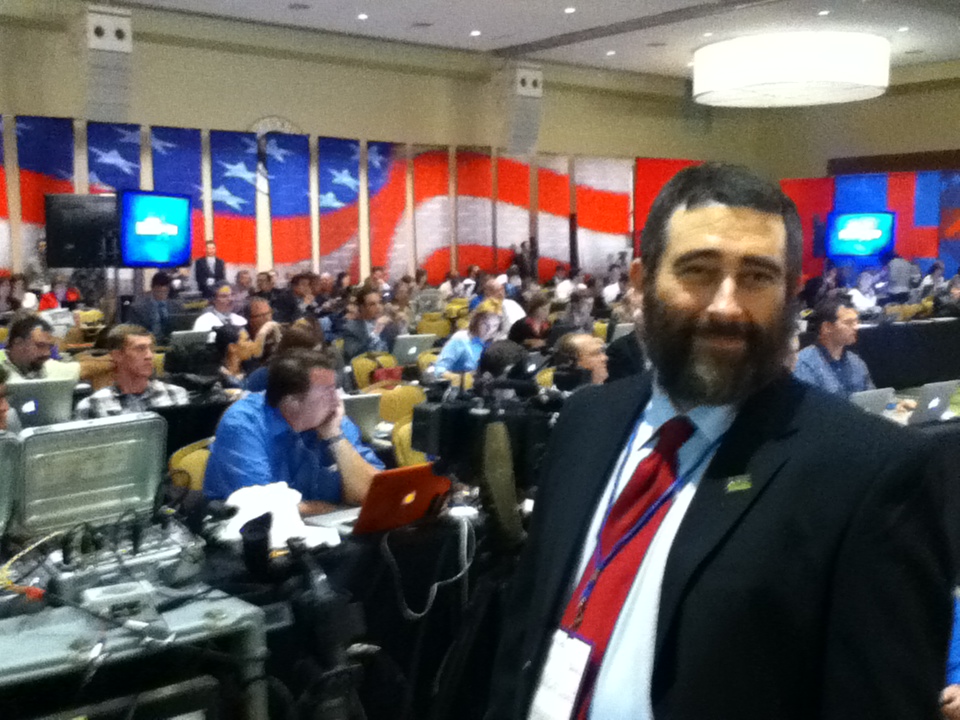
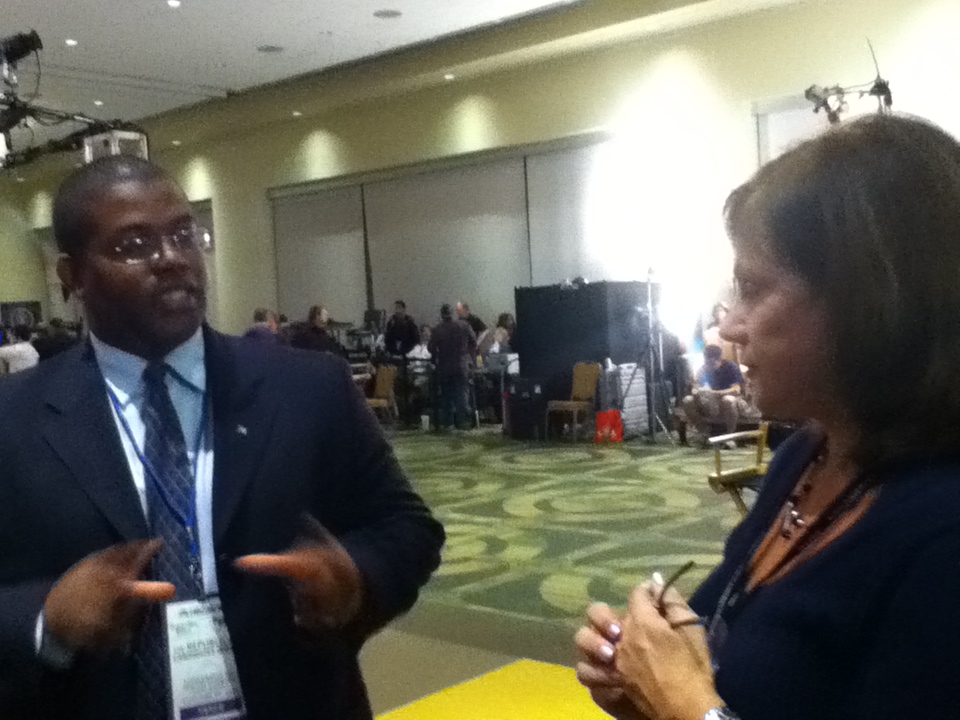
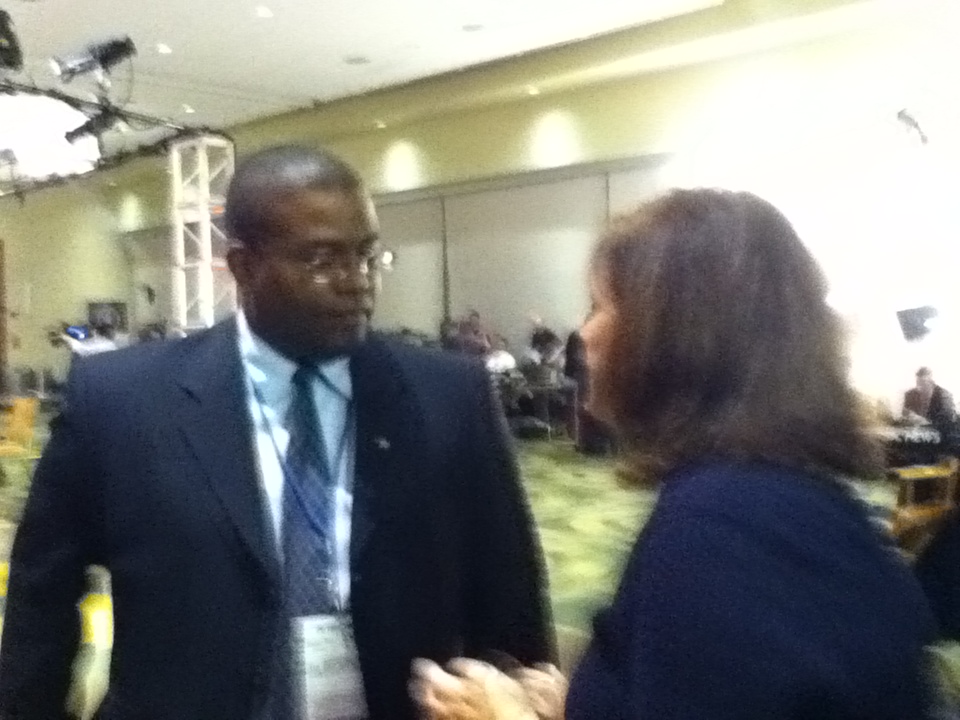
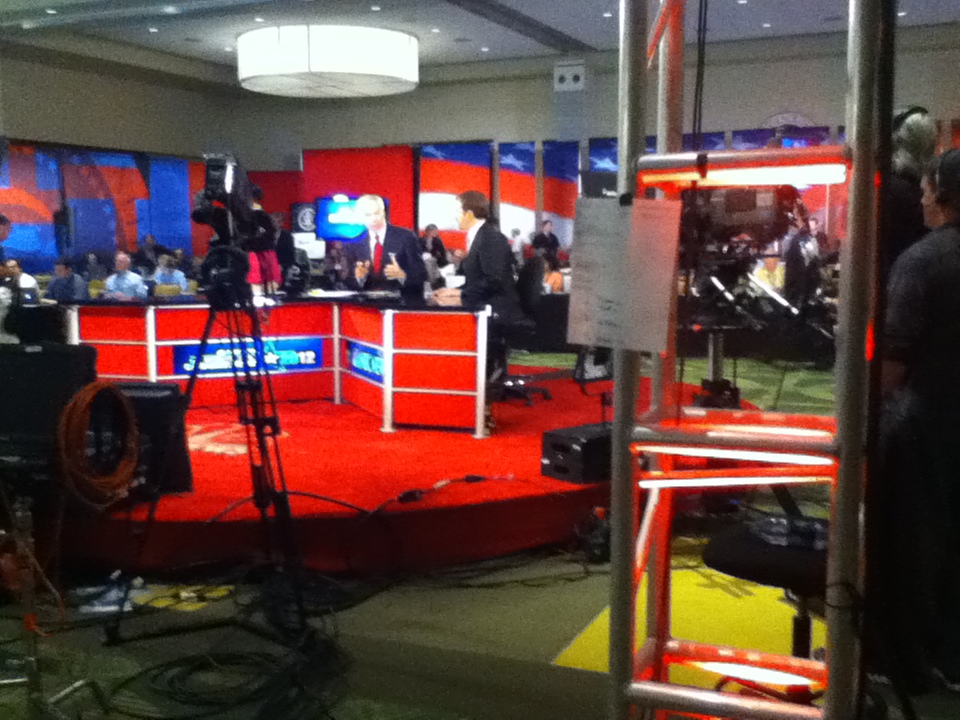
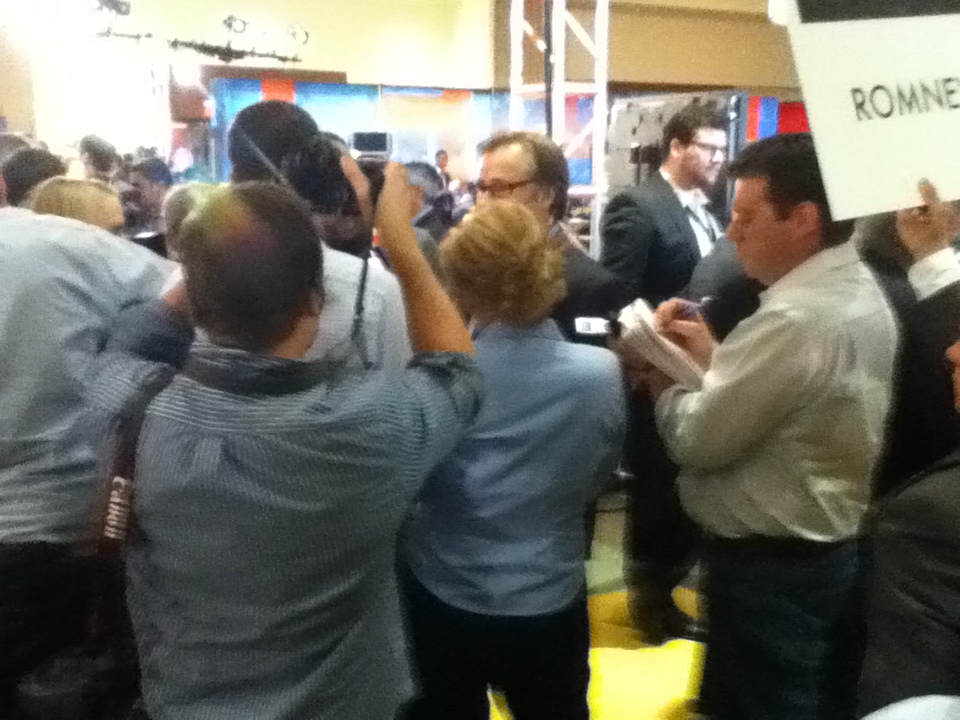
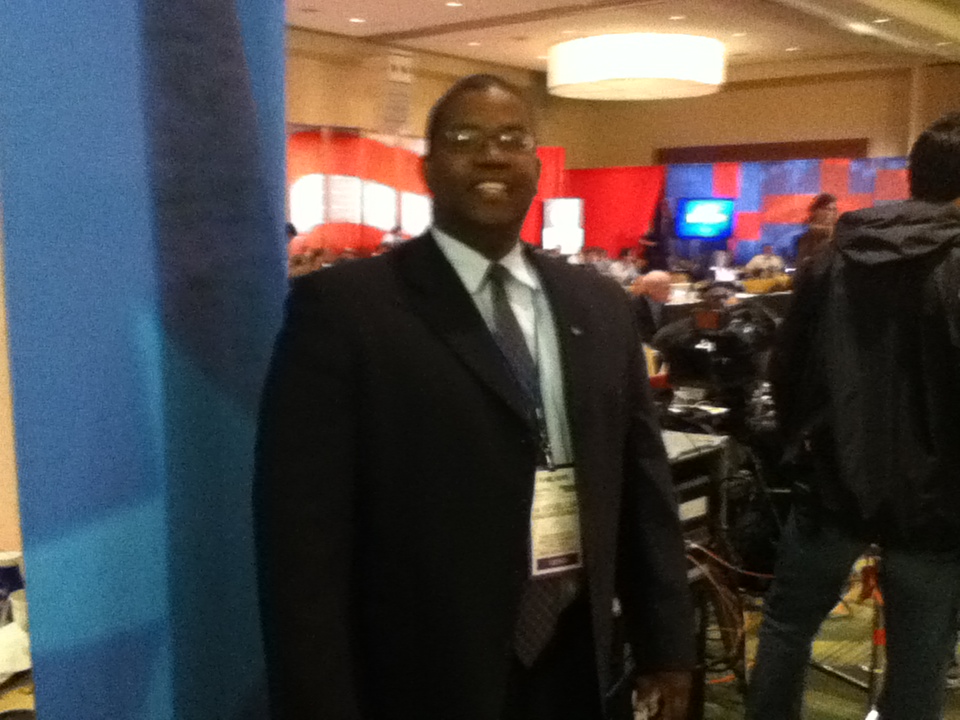
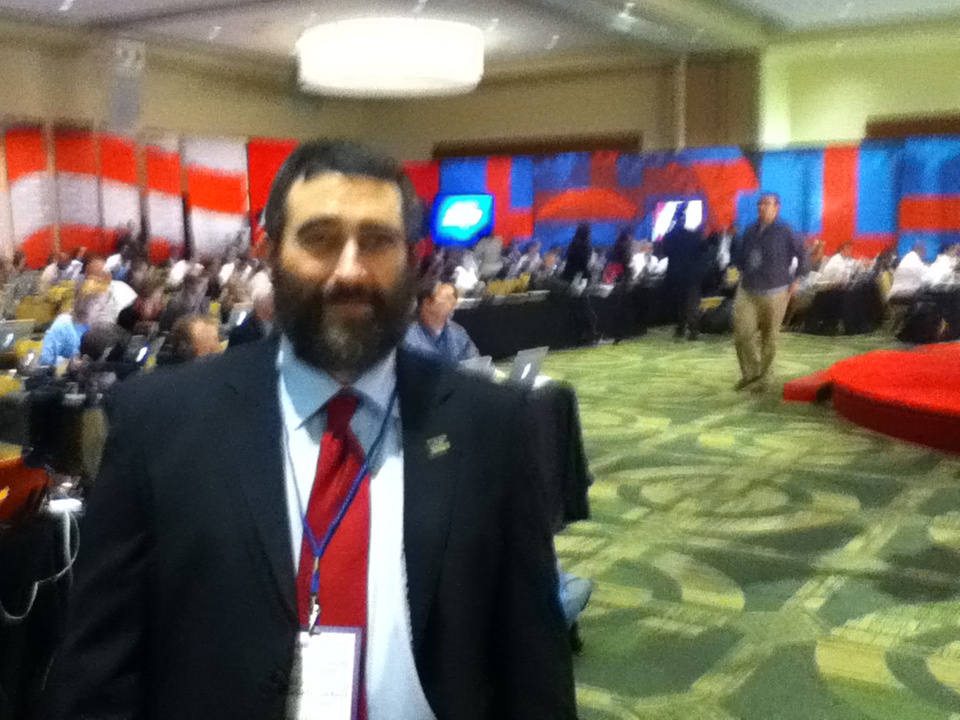
I have a political-debate hangover this morning–not from alcohol but from being on campus for most of 15 hours yesterday and getting home close to midnight. I was one of several USF faculty in the press room last night for the GOP debate on the USF Tampa campus, along with usual political-reporter go-to at USF, Susan McManus, public health professor Jay Wolfson, two colleagues in my college, Anthony Rolle and Paula Cate (the two better-looking folks in the photos below), and several others. Mitt Romney and Newt Gingrich went after each other hammer and tongs, but there were precisely three times that any candidate mentioned education, all in passing and for purposes other than discussing federal education policy. A few reporters came up to the “education faculty placard” and asked questions afterwards, but most crowded around other faculty or the designated campaign spinmeisters (and one of the candidates: Rick Santorum showed up in the press room afterwards).

I am not surprised by the lack of focus on education in this or other debates in this campaign, but I was shocked by a collective error of omission on the part of the reporters in the press room. At the end of the debate, the candidates talked about the Terri Schiavo case, and you might have thought that one of them–one of them–might have asked if anyone at USF might have something to say, especially since there were a few folks from USF Health in the room. If they had done so, USF staff would have told them that Jay Wolfson was Schiavo’s guardian ad litem for a short time early in the controversy and thus had direct knowledge with which to illuminate the candidates’ responses. As far as I can tell this morning, no reporter tried to use Wolfson’s expertise.

But there was plenty of red, white, and blue background for the lack of meaningful reportage, and my mediocre camera took in all the hues:

And now, I need to gather my wits and get ready for work.

Real vs. fake issues in “blogs vs. term papers”

New York Times reporter Matt Richtel positioned Cathy Davidson against William Fitzhugh in this weekend’s Blogs vs. Term Papers article. Currently a Duke University humanities professor, Davidson has experimented with a variety of writing forms she expects from students in her course. As the founding editor of the Concord Review, a journal publishing history essays by high school students, Fitzhugh has long argued for the value of formal research papers. And Richtel makes the most of the contrast between the two articulate teachers: it reads like a genteel cage match between the forces of the New Media against the forces of Tradition.

Continue reading “Real vs. fake issues in “blogs vs. term papers””

iBooks Author: a tool for testing proofs of concept?

Yesterday morning, Rick Perry quit the presidential race and endorsed iBooks Author. Er, no, something else. Oh, yes: Apple unveiled the iBooks Author program that is an easier (if not frictionless) tool for creating ebooks for iBooks, and (not coincidentally), partnerships with the big three text publishers to sell more stuff to schools. There are some very interesting things in iBooks Author, but it’s not magic.

Continue reading “iBooks Author: a tool for testing proofs of concept?”