And… the Florida Board of Education named John Winn interim commissioner until it interviews candidates later this month for a regular appointment. There are only a few candidates with state-level experience. Right now, I'd say the Virginia Secretary of Education Gerald Robinson is a slight favorite over the others. As many others have stated, I'm not sure I'd want anyone I like to have the job (at least for their own health and sanity), as the state is being backed into the corner on a number of issues at the same time that Governor Rick Scott is looking like an extremist with a tin ear.
Send in the peer reviewers
Largely in response to Michael Winerip's celebratory article about teacher peer review in Montgomery County, Maryland, Andy Rotherham argues today that peer review is better at sussing out the "observably poor teaching" than "unobservably poor instruction." Rotherham describes what he means by observably poor teaching: teachers who cannot manage a class, cannot organize material or students, etc. I'm very curious what he means by "unobservably poor instruction," which one comment at Rotherham's blog calls "secret sauce" (i.e., undefined). Or may be we should treat the term as the educational equivalent of dark matter. "Ramp up the LHC, boys; it's time to find those bad teachers!" (That's my quip, not Steve F.'s.)
I have different concerns. First is money. From what I can tell of the peer review in development in Hillsborough County, Florida, it's labor-intensive. That in itself is something to watch: in a system where certified teachers are with students 100% of the instructional day*, can a school system without Gates money afford the type of intensive observation system Hillsborough is trying? For this question it doesn't matter whether the observers are fellow teachers or assistant principals or some other group, though I very much think peers or former teachers from outside the school are the better choices. The point is that the time of certified teachers is expensive and limited. If your budget revolves around that 100%-certified-teacher time, the budgetary consequences of peer review may get very interesting for my local school system in four years' time.
The second concern is culture and scale. Here, the problem is in scaling down, not scaling up. In a large school district such as here in Hillsborough County or in Montgomery County, a peer review system can be developed at the district level with a reasonably consistent approach. In a large district, you can have observers be from outside the school. But what if you're in one of the tiny New Jersey districts where there is one or two schools per grade level? I can easily see something that's called peer review but has all the problems of an incestuous faculty culture (whether it's mutually destructive or get-along-go-along). And what if peer review looks very different in Teaneck than in surrounding districts such as Bergenfield, Hackensack, Englewood, and Englewood Cliffs? Then the problems of peer review will feed into the same small-district politics we see today instead of being a solution.
* I mean by that the model that relies on the presence of a certified teacher wherever students are in a classroom. Teachers do have planning periods, on a relatively limited basis in most of the U.S.
The Uncertainty Research Building directory
This is probably an indication of some sad psychological condition, but I left the THATCamp bar get-together early tonight because I'm behind on grading for my summer course, and two doctoral students deserve some time as well for some finishing-up details. But the same building that houses the Roy Rosenzweig Center for History and New Media at George Mason University also houses a quantum-physics research center. And looking at the diversity of the directory gave me some ideas (long before anyone from the unconference hit the bar). So, for a short break in grading…
Uncertainty Research Building directory
Center for Quantum Research: Floor 2 and/or 4
Statistical Research Institute: Floor 3 +/- 1
Group Symmetry Group: Floor [it doesn't really matter, since we'll move to your floor within a few operations]
Poststructural Collective: "Floor" "5"
Topology Program: Bowl 3
What did Japan do? (the unpleasant parts)
We've taken the most likely road out of the financial crisis of 2008: avoiding Armageddon and getting stuck instead in an economic bog, which is neither horrific nor good. Krugman talks about a Third Depression, by which he means an overall slump of more than a decade. What we are seeing right now looks to be an all-too-predictable long-term period of low economic growth following a financial crisis, but regardless of its predictability from 2008, here is where we are three years later. This was not inevitable by any means, but Obama shot low on the stimulus and especially screwed up with his (non-) appointments to the Fed, and much of the political world on both sides of the North Atlantic is just bonkers and repeating a good part of the range of macroeconomic mistakes from the Great Depression. As an historian, I should note that this is par for the course (the missteps and bonkers bits). But we face this slump as a country that is wealthier than almost any other country in similar circumstances and with a fairly well-developed public sector (if lumpy in both size and performance). On the other hand, we have an aging population and an extraordinarily dysfunctional public debate over the most rapidly-expanding cost of aging (health care).
But we are not alone. Today, several European countries such as England (yes, it's part of Europe!) have the historically-relative wealth if not the health-care dysfunction, and that comparison is likely to dominate vapid punditry when the vapid punditry deigns to look outside our borders. (I am convinced that the bloated reputations of Thomas Friedman and David Brooks are in large part because they are less insular than George Will and other columnists with lifetime tenure.) But another country has gone before us in being a very wealthy, aging nation heading into years of subpar economic growth: Japan in the years after 1990.
On the one hand, the recent macroeconomic history of Japan is sobering: years of too little, too late. On the other hand, life expectancy in Japan did not drop the way it did in post-Soviet Russia, there has not been extraordinary crime, and more generally there doesn't appear to have been a collapse in civilization. So maybe we need another spate of "what did Japan do?" hype stories. Well, let's skip the hype but maybe keep the comparative focus…
Timed emails through Blackboard announcements and Polleverywhere
Two tips for the savvy instructor from the clueless professor:
1) Timed emails. I just came across one redeeming feature of Blackboard (the "learning management system" that my university uses): I can use the announcements feature to time an email to students in a course. At least at USF, faculty can send a copy of the text of announcements to students through a checkbox in the create-announcements page. Then, if you set a specific day and time for the announcement to be visible to students (by default it is "live" instantly), then the email goes out to students the same time the announcement becomes visible.
In other words, I can use Blackboard to send out emails at a time of my choosing (and thus plan nags… uh, reminder emails to go out at critical points in the semester). This is something I've wanted for a good long while, because I can then set up emails at the start of a term, and they go out on schedule.
2) Polleverywhere for from-anywhere comments by students. I have had a Polleverywhere.com account for a few years and have occasionally used in classes as an alternative to clickers — most commonly I have used it to draw out students' preconceptions during class, as I did below in a class last week:
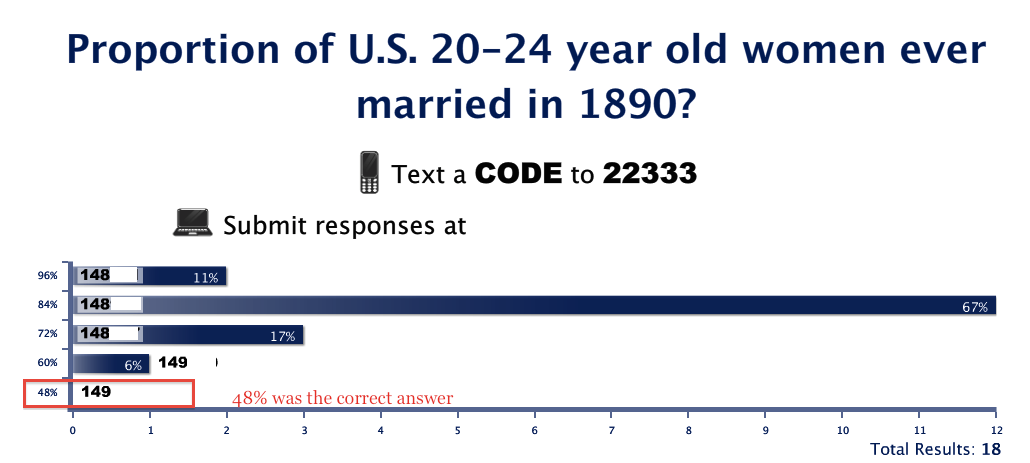
One of the points of a class session or two devoted to family history is the way we assume that the Baby Boom years represented the norm in American history, when in many ways–as in early marriage–the immediate postwar years were the exception. So in this case, I ask students who have cell phones to take them out and send a brief text to report what they think the answer to a question is. Then, once I have them committed to a consensus that the vast majority of young women were married across long stretches of U.S. history, I hit them with the fact of late marriage patterns. (The correct answer is the one boxed in red at the bottom… which no student selected.)
But Polleverywhere can also be used for text responses, and once I realized that Blackboard allowed timed emails, I set up a query on Polleverywhere that lets students comment anonymously on the reading assigned over the weekend. I have wanted there to be some way for students to comment on reading from wherever they are, whenever it strikes them, but without having them to get a Twitter account. This allows students to send a question the second they have it, if they have a cell phone handy with text messaging. They don't have to have a computer open (though they can also respond through a browser form). I did not send out the prompt and the answer code immediately–many of them are working through some quizzes on this week's readings. But they will get the email Sunday inviting them to comment on the readings. I will quickly see whether this flops or shines…