Thanks to Alexander Russo, I just saw Jeff Danziger's October cartoon about an apparent "great wave" overtaking American education:
The apparent inspiration for this visual repetition of the first paragraph of A Nation at Risk appears to be Hokusai's Great Wave:
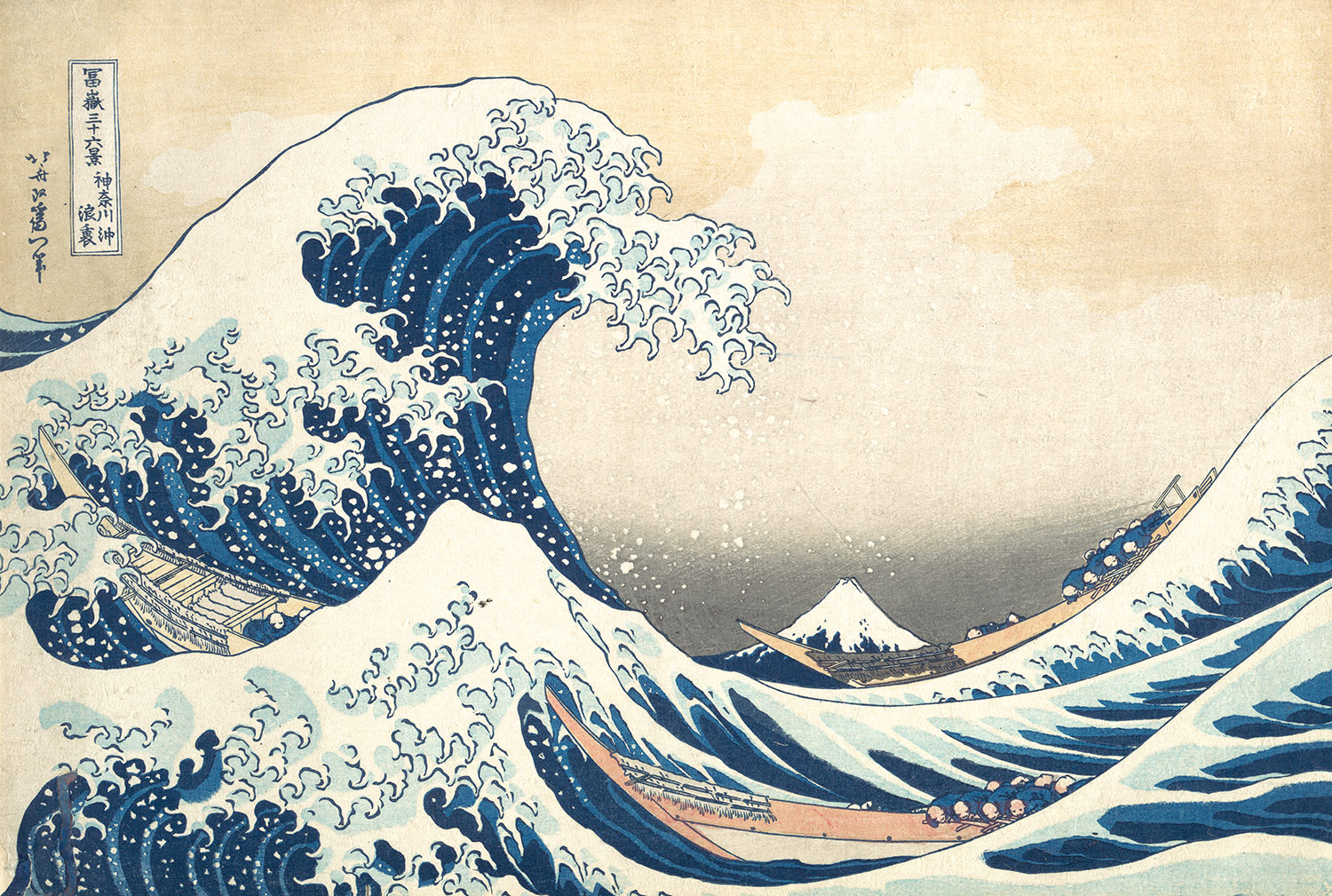
Apart from repeating confectionary fairy tales written by Tom Friedman, Danziger can't tell his East Asian countries apart. Hey, buddy: next time, remember to use the scary image that's from the country that's experienced recent economic growth, not the formerly scary East Asian country whose schools we were trying to emulate in the 1980s, before the country underwent an eerily familiar liquidity trap in the 1990s.
(For those who are curious: the fair-use display of images in this entry is for purposes of social criticism. And I strongly recommend visiting the Metropolitan Museum of Art in New York, where you can see the original–the original Hokusai, that is.)
Danziger is being very literate, I think. Public education is in dangerous straits, just like the skiffs in the Hokusai picture about to be up-ended by the massive wave.
The crunch comes for the same reason that Washington is trying to get China to devalue its currency — because, sadly, it is the only thing that can be changed. China now fills the lower tier of the global production model, and there is no turning back the clock — there is no way to bring that back to the US.
This means that the blue collar jobs in the US that have vanished in the past ten or twenty years will not be there for kids leaving the public schools with only a high school diploma, or less.
But the response to this has been just about as hare-brained as Washington trying to get China to consume its own surplus production, easing the pressure on the lower tier in the US. And what response is that? To boost college degree production. This means, in Florida, re-norming standardized tests like the FCAT in order to align them with more realistic college entrance requirements, and then putting hapless students on the treadmill. Just like in New York.
It’s like a treadmill going maybe 5-7 mph, then suddenly, without warning, ramping it up to 30, 40 and 50 miles an hour. Many students don’t stand a chance, and will be flung off, with teachers scraping their minds off classroom walls.
This is how I see it. Maybe I am wrong, and I hope I am. But just wait until the same kids who were able to make it through the AP and dual enrollment courses, wait until they get to college, and they learn that it’s all just prep for graduate school, where the treadmill is moving at 60, 70 and 80 miles an hour.
I agree the analogy is poor, but I think it’s because it draws a parallel that isn’t present.
Education is more like a liquid that slops around a wash tub. Schools are bits of wood put in by children at play that want to grow up to be famous. Schools are pushed around at random since the tub is a self-referential circle and there’s nowhere to go.
The storms are imaginary but the pushing and shoving around the tub is real.
No sure it can be carried further, but it is entertaining to consider. That’s the importance of analogies. We can use them to reflect. Bad ones are dangerous and bad ones in the hands of powerful people are doubly so.
I agree with Bob when he said, “That’s the importance of analogies. We can use them to reflect. Bad ones are dangerous and bad ones in the hands of powerful people are doubly so.”
>The storms are imaginary but the pushing and shoving around the tub is real.
This invites an application of the Thomas Theorem (1928: 572), which states simply that:
“If men define situations as real, they are real in their consequences.” So, even if the tidal wave is imaginary, it is real in its consequences.
Besides, pushing and shoving are what make the (stratified) world (of conflict sociology) go ’round. Like with North and South Korea, the consequences of pushing and shoving can be enormous. Nothing imaginary about that particular storm.
>I agree the analogy is poor, but I think it’s because it draws a parallel that isn’t present.
>Education is more like a liquid that slops around a wash tub. Schools are bits of wood
>put in by children at play that want to grow up to be famous. Schools are pushed
>around at random since the tub is a self-referential circle and there’s nowhere to go.
Cute. But schools are also bits of wood put in play by adults with visions of grandeur. And schools *were* self-referential (i.e., loosely coupled), until NCLB and VAM, et. al., started pushing them out of the loop, toward tighter coupling with their organizational field. This is the tsunami I was referring to.
Colleges and universities are at risk as well. All that Bob says also applies to them. In terms of loose coupling, they are about where the secondary schools were 30 or 40 years ago (?). So, the move to tight coupling now would mean compressing a few decades of reform into a few years, and — given the high levels of resistance to any kind of micro-controls and/or standardization, from the institutions’ POV — could be credibly characterized as a tsunami.
“China now fills the lower tier of the global production model”
That is not true any more. The lower tier is outsourced to other parts of Asia, and many Asian companies have major production facilities in the US. Glen, are you completely ignorant of the large investments KIA is making in the US? Those blue-collar jobs are going to be here, but not at UAW wages and benefits.
China is doing its best to fill the tier that makes high-end products like lithium-ion batteries and the cars they go in, as well as other consumer products that have a great deal of added value (Lenovo computers). And Lenovo, like other companies headquartered overseas, has R&D operations in the US.
Glen, you are right that an imaginary tidal wave can have real consequences (negative ones if you try to change something under false pretenses, like claims that Social Security is broke or that there wasn’t a major tax cut last year). Our job as educators is to hold up the mirror of reality and call b*s* by its real name. For example, when you equate AP calculus in HS to the “consumer math” classes that baby sit students who can’t do 9th grade algebra, you make a major error, but you are surely correct that raising HS grad standards to college level math would be a disaster in the short run.
The problem with AP classes is that they go at half the rate of the equivalent college class, sending a bad message about college for students going to elite schools. I am unaware of any issue related to taking a regular college class as a dual-enrolled student. In my experience, dual-enrolled students who pass calc I are generally better prepared than students with AP credit for calc I. The latter have not had to study on their own.
Hi CC.
Maybe it doesn’t matter to whom — first it was Japan, then Mexico, now China, Asia (Bob says Africa) — the lowest tier of global production has shifted (although my stuff from Walmart still says “Made in China”) — the response is what matters.
And that response is a self-created Tsunami of change and reform, from value-added to Sunshine Standards that cannot figure out how to stay put for a couple years. And it will drown the kids and parents and teachers in the schools that are now barely afloat.
Part of the analysis of China’s hi-tech boom (they are producing their own bullet-trains now) needs to include the levels of overeducation in that country; and how the over-supply of trained engineers is apt to create its own demand for them, especially in a controlled economy. Overeducation in this country (I have seen it argued by economists) is responsible for the emergence of the service industry as we know and love it.