Public policy can override professional judgment, but very cautiously

This afternoon I’ve been in a Twitter exchange with Benjamin Riley over the issue of when public policy can override teacher judgment and how much the current wave of reformy legislation is ignoring teacher judgment. (Or, rather, I’ve been moderately active while he’s been in a much broader Twitter exchange.) I pulled out the obvious and easy trump card: Florida’s SB 736, which is a little hard for anyone who didn’t vote for it to defend as great policy or as having been generated with significant teacher input. ((When Rick Hess tells a Republican legislature that it’s being unreasonable,…)) Much to my surprise and disappointment, Riley pulled out the “well, they were heard and ignored” explanation:
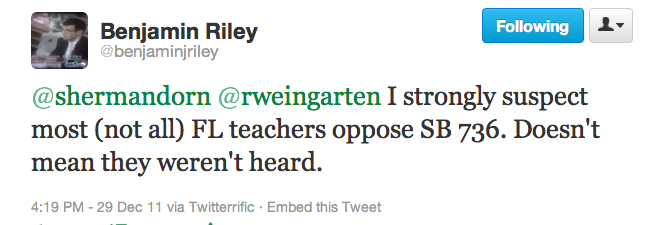
That’s an interesting glimpse into his views of teacher judgment, or rather I hope it is not reflective of a generally dismissive attitude.

But let me look more closely at the policy question: under what circumstances is it reasonable for public policymakers to override the professional judgment of teachers (or doctors, engineers, etc.)? “Well, the legislature thought differently” is fundamentally a formalistic response, since the fact that an elected body has an official opinion doesn’t say anything about the substantive wisdom of the policy. Same with any version of Politician’s Logic (something must be done; X is something; therefore we must do X). So some modest ideas on when overriding professional judgment is reasonable:

  • Pinpoint evidence on a specific practice: When a significant body of technical evidence suggests that continuing a common practice is unwise or unwarranted. Example: when significant evidence begins to appear that a particular surgery technique is no better than a placebo, and practitioners continue the surgery without considering the research, then overriding professional judgment is plausible with the consideration of an independent expertise-based panel (as the IPAB is designed to do in the Affordable Care Act). Limitation: This is about specific practices that you could imagine Atul Gawande writing about in The Checklist Manifesto. It is not about general structures of a profession.
  • Pilot for thorny problem: When the policy question is a limited pilot addressing a significant problem, when the proper response is not clearly guided by existing evidence, and when the professionals at hand have not offered alternative ideas. Example: In several states, governments have experimented with different Medicaid payment plans to address cost issues, often with vehement objections from providers. Running a pilot is reasonable when it is run to provide evidence to address the concerns of professionals as well as the larger public policy questions at issue. Limitation: if you’re going to run a pilot, you need to be committed to following where the evidence leads; if the evidence points to failure of the pilot, you shut it down and don’t continue to argue for it.

This is not an exclusive list, but since the question at issue is where professional judgment could be overridden, I wanted to generate a few “use cases” for discussion.

More broadly, I am arguing that the existence of such specific case for overriding professional practice indicates the importance of doing so very cautiously and deliberatively rather than in a knee-jerk fashion.

On a change at USF Polytechnic

President X may need to leave for the college-community relationship to be what her or his lip service has claimed is the ideal… because the reality of that has to exist on campus, not just in the head of President X.

What I wrote a short while ago in Dead administration walking and the higher ed Klein bottle myth.

This statement applies as well to “Chancellor X” for the head of a campus inside a larger system.

Power and authority in oral history, public history, quantitative social history, and now digital history, …

Thus far, submitting a chapter for Writing History of the Digital Age has been one of the more engaging and enjoyable bits of writing and scholarly interaction I’ve had in almost a quarter century in my field. The public discussion (including comments by the peer reviewers for the press) has been productive from my perspective as an author, as I wrote in late November: “When I submitted this essay, I was not certain if it would get a rise out of anyone or just get a ho-hum, so what? reaction. Instead, I have a wonderful set of comments challenging me to think about the potential value of long-form arguments on multiple levels as well as missed opportunities for digital history to engage in argumentation.” At this point, I’m supposed to turn around a revised chapter by January 20, which is more of a challenge than non-academics might think!

Continue reading “Power and authority in oral history, public history, quantitative social history, and now digital history, …”

Does Sherman Dorn hold a double standard on interview studies?

Rick Hess writes in response to my last entry commenting on a piece by Ben Wildavsky that I “snarked that the research was qualitative and that Ben didn’t offer up a quantitative analysis. Now, I thought it interesting that education scholars who often argue the merits of methodological diversity (an argument I heartily endorse, so long as the work in question is well done ((emphasis added))), were quick to lash out at qualitative work whose conclusions they disliked. But, more to the point, I don’t recall any of these same concerns being raised about the qualitative, anecdotal, and interview-driven hit jobs done against for-profits recently by The Nation or the New York Times. How about it, folks? What’s the deal?” Just a few things:

  • Hess is assuming I disagree with every observation of the former elite-school administrators on the public/non-profit side who moved to for-profit universities. He’s jumping to conclusions just a wee bit: the failure of Wildavsky to meet Hess’s “well-done” criterion is what made my eyes roll.
  • Regarding the double-standard accusation, I guess Hess didn’t read what I wrote about Stephanie Mencimer’s and Lee Fang’s articles on either October 19 or November 27. I wouldn’t call either of my comments drooling approval of the articles, and I haven’t commented on the most recent (NY Times) article Hess links to. I can’t demand that my blog be made required reading at AEI, but if you’re going to accuse me of a double-standard, you may want to check I’ve held a double standard you can document.

Here’s another way to slice my concern: I strongly suspect that if Geri Malandra had moved from the University of Texas to Cal State Long Beach or Miami-Dade College instead of Kaplan, and if everyone else interviewed by Wildavsky had had a chance to be an administrator at Cal State Long Beach, Miami-Dade, or similar public and non-profit teaching-oriented institutions, the researchers vs. teachers comment would have been framed as public flagships and private research universities vs. the workaday world of the majority of the public and non-profit sphere. Taking all comments from interview subjects at face value led Wildavsky to a narrow frame, by ignoring the larger reality of higher ed. That’s why the conclusions drawn about faculty at public and non-profit colleges and universities vs. faculty at for-profits is specious and an example of researcher indulgence.

If I were sitting on a dissertation committee for a student who wanted to interview people who had moved between public, non-profit, and for-profit institutions, I would strongly suggest finding people who moved between similar roles and institutions with at least plausibly similar missions. There are plenty of such people, including those who move from public to for-profit and back to public (as the anonymous Dean Dad has done), and it would make sense to take advantage of faculty and administrative swirling in such a study. ((“Swirling” is usually used in higher ed to refer to students who move between multiple colleges and universities as undergraduates, but we might as well use it to refer to faculty and administrators who also move between different sectors.)) But let’s face reality: Geri Malandra was hired last year to provide cover for Kaplan after a huge publicity hit. Other former administrators from elite, research institutions are unlikely to be hired by the for-profits for their expertise in teaching initiatives. Wildavsky’s interview paper uses a sample of convenience and draws generalizations that are unwarranted from the positions of his interviewees.