Congratulations to all 308,745,538 of us! I'd link to the Census Bureau website, but I think it's crashed under a huge weight of traffic. Update: The Census Bureau website has evidently recovered.
Florida achievement gaps, the data
The following is more of a useful reference for me than anything else, but since I've been asked a few times about the "everyone else behave like Florida" argument floating out there, here is (in Excel format) Florida NAEP scale score data through 2010, with selected demographic groups.
Some caveats: you'll see different starting dates because of changing accommodations provided in the NAEP tests, so rather than try to wade through that, I have not included scale scores when the accommodation rules were different. In addition, one item that is not here is the proportion of the sample frame excluded from tests for various reasons.
Rep. Bill Young’s missed opportunity on DADT repeal
Now that Congress has passed the don't ask, don't tell repeal, the final House roll-call last week on the measure was probably the last legislative action Rep. C.W. (Bill) Young will take regarding discrimination based on sexual orientation. While others celebrate Young's political longevity, it's important to acknowledge that from his beginnings in the Florida legislature in the 1960s, Young acted in critical ways against fair treatment of gays and lesbians.
While his vote against the DADT mandate in Congress was not particularly critical (until January, he's in the minority, and the bill passed the House comfortably), his political career began in the firestorm of Cold War homophobia. In the Florida legislature, as documented by Jim Schnur in a chapter for an anthology on gay and lesbian history in the South, Young was a member of the Charley Johns Committee, which turned to a witch-hunt for gays in schools and universities after failing to find enough Communists in the Florida civil-rights movement and enough Communists in schools and universities. In defending the actions of this witch-hunt in the 1960s, Young said that the legislature "has responsibilities to the public to expose these people" (p. 150, referring to gays and lesbians).
Today, most Floridians who know the story of the Johns Committee recognize that the committee represented the worst of Cold War hysteria to justify suppression of the civil rights movement and then, in Florida, attacks on gays and lesbians. To his dying day, Charley Johns defended his actions as head of the committee. I don't know if Bill Young ever apologized for his own involvement in the Johns Committee, but he had an opportunity to make up for it by voting for DADT repeal. I am disappointed that he failed to take that opportunity to redeem his actions in some small measure.
Nominations for top education stories of 2010
I'm getting around to this a bit earlier than usual in December: what were the big education stories of 2010? Nominate your picks in comments! Comments will close on the 23rd, and I'll describe my picks in the last week of the year.
“Efficiency” vs. “accountability” in education discourse (one tiny and friable slice)
Like many others, I’ve been enjoying playing for at least a few minutes with the new Google Ngram viewer. So what can one see when you put in the phrases school accountability and school efficiency in the Google Ngram search box?
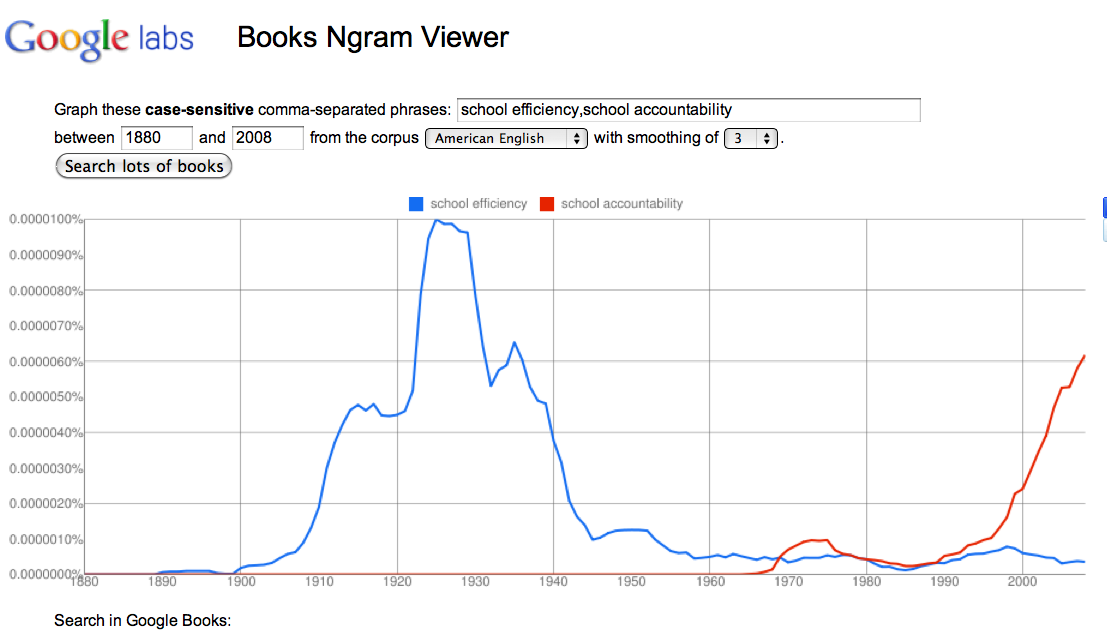
The blue line is the proportionate set of sources in the Google database (by year) with references to “school efficiency,” and the red line the proportionate set of sources with references to “school accountability” (each smoothed, I think an average of three years). “School efficiency” references peaks around 1925 (at one reference in every ten million sources or so); “school accountability” references begin to appear at the end of the 1960s and are still rising. Given the incomplete nature of the Google database, the relative amount of print matter over the time series (and thus the ability of a small professional literature to look much larger in the early 20th century than a similar or even larger bit of rhetoric half a century later), and all the vagaries of picking different keywords (or phrases), all I can comfortably conclude here is about timing, not dominance: that efficiency is an older term used in the “run schools as businesses” public rhetoric, and accountability is a term that has been in use only in the past 50 years and picked up steam in the 1990s. Not that this is a surprise to an historian of education…
I started with the question of whether the Ngram viewer would provide evidence of the conclusion that I had reached in my research in the 1990s, that dropout only became a prominent term in the 1960s. It does.
More on the limitations and addictive quality of the Ngram viewer over at Dan Cohen’s blog. If you’ll forgive my bastardized Latin, caveo computus.